Table of Contents
What is Pertussis (Whooping Cough)?
- Pertussis, commonly known as ‘whooping cough’, is a highly contagious respiratory infection caused by the bacterium Bordetella pertussis.
- Pertussis is also known as the 100-day cough due to its longevity and severe violent coughing fits (sometimes ending with a whoop sound).
- Pertussis is dangerous for the infants. However, its vaccine preventable.
Why Pertussis Remains a Global Health Threat?
- Pertussis continues to pose a significant global health concern despite widespread vaccination.
- Infection rates declined after successful vaccination campaigns, but the disease persists due to several factors:
- Waning immunity: Protection from vaccination or previous infection decreases over time.
- Vaccine hesitancy: Low vaccine uptake in some communities allows continued transmission.
- Improved diagnostics: Better detection increases reported cases, highlighting ongoing outbreaks.
- Pathogen evolution: Genetic changes in Bordetella pertussis can reduce vaccine effectiveness.
- Severe complications, such as pneumonia and respiratory failure, increase morbidity and mortality, particularly in infants, amplifying its impact as a global health problem.
Pertussis vs Common Cold
- Common Cold: mild cough, short duration
- Pertussis: prolonged cough, vomiting, apnea in infants
What are the Causes of Pertussis?
- The main causative agent of pertussis is Bordetella pertussis bacteria.
- Bordetella pertussis is a small, encapsulated, non-motile, gram-negative coccobacillus that grows in the presence of oxygen and requires specialized media for culture.
- Humans are its sole reservoir. Transmission occurs via respiratory droplets, and the bacterium specifically colonizes the nasopharynx by attaching to ciliated epithelial cells.
How Pertussis Toxin Damages the Respiratory Tract?
- Bordetella pertussis bacteria (Whooping cough bacteria) attach to the cilia (tiny, hair-like extensions) that line part of the upper respiratory system.
- The bacteria release toxins (poisons), which damage the cilia and cause airways to swell.
How Does Pertussis Spreads/Transmit?
- Whooping cough bacteria spread easily from one person to another through the air.
- When an infected person coughs or sneezes, tiny droplets containing the bacteria are released.
- These droplets can be inhaled by people nearby, leading to infection.
- Transmission is more likely when people spend long periods together or share the same enclosed air space.
What are the Risk Factors of Pertussis?
Age
- Babies younger than 1 year are at the highest risk of getting whooping cough and developing severe complications, especially if they are unvaccinated or have not completed all recommended vaccine doses.
Medical conditions
- People with underlying health conditions that can be aggravated by whooping cough are at increased risk of severe infection.
- These conditions include, but are not limited to:
- Immunocompromising conditions
- Moderate to severe asthma requiring medical treatment
Why Whooping Cough is Dangerous for Babies?
- Anyone can get whooping cough, but it is more common in infants and children.
- In infants, the illness can be particularly severe and may be life-threatening.
- More than half of infants younger than 1 year who get whooping cough require hospitalization/serious medical attention.
- Older children and adults often transmit pertussis to infants and young children.
What are the Stages and Symptoms of Whooping Cough?
Stages of Whooping Cough
1. Catarrhal Stage: Early Cold-Like Symptoms
- Duration: 1–2 weeks
- Symptoms:
- Runny or stuffy nose
- Sneezing
- Mild cough
- Low-grade fever or no fever
- Watery eyes
- Fatigue
- This stage closely resembles the common cold.
2. Paroxysmal Stage: Severe coughing stage
- Duration: 2–6 weeks (sometimes longer)
- This is the most characteristic and dangerous stage of whooping cough.
- Symptoms:
- Severe coughing fits (paroxysms)
- Rapid coughing followed by a high-pitched “whoop” sound on inhalation
- Vomiting after coughing episodes
- Extreme exhaustion after coughing
- Facial redness or bluish discoloration of lips during coughing
- Production of thick mucus
3. Convalescent Stage: Recovery Phase
- Duration: Several weeks to months
- This is the recovery phase, during which coughing gradually decreases, although the airways remain sensitive.
- Symptoms:
- Persistent cough lasting several weeks
- Temporary worsening of cough with colds or physical exertion
- Gradual return of energy and appetite
How is Pertussis Diagnosed?
- Pertussis (whooping cough) is diagnosed using a combination of clinical assessment and laboratory tests.
- The choice of test depends on the patient’s age, stage of illness, and duration of symptoms.
Culture
- Considered the gold standard for diagnosis because it is highly specific.
- Best performed during the first 2 weeks of illness, when viable bacteria are still present.
- Sensitivity is lower than PCR and results take longer (7–10 days).
PCR
- PCR is best done in the first 3 weeks after coughing starts.
- It looks for the DNA of the whooping cough bacteria.
- The test uses a swab or fluid taken from the nose or throat.
- Results are quick, so it is commonly used to diagnose whooping cough.
Serology Tests
- Most useful in the later stages of disease (after 3–4 weeks of cough), when PCR and culture are less likely to be positive.
What are the Challenges in Diagnosing Adult Pertussis?
- Adult pertussis symptoms are often less typical, making diagnosis difficult.
- A paroxysmal cough without fever can identify many pertussis cases, but this pattern is not always clear in adults.
- Adults often do not have the classic “whoop” sound, so doctors may rule out pertussis incorrectly.
- Inspiratory whooping and vomiting after coughing help rule out other infections, but these signs are less common in adults.
- Clinicians may not consider pertussis in adults, thinking it is mainly a childhood disease.
- Many adults are tested only after a long-lasting cough (30–50 days).
- PCR tests become less accurate in later stages, increasing the chance of false-negative results.
- Serology tests are therefore important for diagnosing pertussis in adults, especially in late disease stages.
- Diagnosis in adults is often delayed, and many cases likely go undiagnosed.
What is the Treatment for Pertussis?
Antibiotic Treatment for Pertussis
- Macrolide antibiotics (azithromycin, clarithromycin) are commonly used
- Most effective in early stages
- Reduce contagiousness even if symptoms persist
Supportive Management and Hospital Care
- Oxygen therapy, if needed
- IV fluids for dehydration
- Monitoring breathing in infants
- Suctioning of mucus
Treatment of Close Contacts (Post-Exposure Prophylaxis)
- Family members and other people who have been in close contact with your child may also start on antibiotic therapy, regardless of whether they have received the vaccine or not.
What are the Prevention and Control Mechanisms for Pertussis?
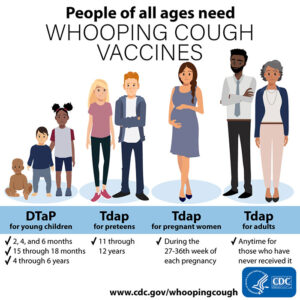
Pertussis Vaccine (DTaP/Tdap): Schedule and Booster Doses
- DTaP – for young children
Schedule:
- 2 months
- 4 months
- 6 months
- 15–18 months
- 4–6 years
Tdap – for preteens
- Given once between 11–12 years
Tdap – for pregnant women
- During each pregnancy, ideally between 27–36 weeks
Tdap – for adults
- Anytime if they have never received Tdap
Maternal Immunization and Infant Protection
- Pertussis vaccination during pregnancy, especially around 28 weeks, reduces infection in infants for up to 8 months.
- Maternal pertussis immunization is highly effective, with studies demonstrating a 70–95% reduction in the risk of pertussis disease among newborns and young infants.
Community-Level Prevention Strategies
- Increase awareness among mothers, families, and communities about whooping cough, its spread, symptoms, and prevention.
- Educate families and communities on the importance of vaccination and following the pertussis vaccination schedule.
- Emphasize the importance of timely uptake of each vaccine dose to ensure optimal protection and prevent outbreaks.
- Strengthen community health workers on pertussis for counseling and early detection.
- Promote hand hygiene and respiratory etiquette.
- Advise avoiding close contact with suspected or confirmed cases, especially for infants and pregnant women.
- Strengthen community reporting for early detection and response.
Public Health Significance of Pertussis
Pertussis Epidemiology and Outbreaks
- Worldwide, there are over 24 million pertussis cases annually, causing more than 160,000 deaths.
- Over the past 30 years, childhood pertussis incidence, mortality, and DALYs have declined globally.
- Low SDI (socio-demographic index) regions still experience a high pertussis burden.
- Between 2019 and 2022, during the COVID-19 pandemic, pertussis incidence rates dropped markedly.
Waning Immunity and Vaccine Effectiveness
- The whooping cough (pertussis) vaccine is highly effective when all recommended doses are given.
- DTaP protection wanes over 5 years after the fifth dose.
- Children become less protected as time passes since their last shot.
Surveillance and Reporting Systems
- Pertussis is a nationally notifiable disease.
- Healthcare providers must report suspected cases to the health department.
- Laboratories must report all positive test results.
- In countries with DPT3 coverage <90%, report monthly aggregated cases by age.
- In countries with DPT3 coverage ≥90%, case-based reporting is recommended.
- All outbreaks should be investigated immediately with case data collected.
Frequently Asked Questions (FAQs)
How Long Does Whooping Cough Last?
- The whooping cough can last 6–10 weeks or longer, especially if treatment is delayed.
Is Pertussis Contagious in Adults?
- Yes, pertussis (whooping cough) is contagious in adults, even though the symptoms are often milder than in children. Adults can infect infants and vulnerable people.
Can Vaccinated Children Get Pertussis?
- Yes, vaccinated children can get pertussis, but symptoms are usually milder and complications less severe.
References and For More Information
- https://www.sciencedirect.com/science/article/abs/pii/S0196439925000327#:~:text=rights%20and%20content-,Abstract,the%20persistent%20threat%20of%20pertussis.
- https://serology-education.com/index-of-pathogens/bacteria/bordetella-pertussis-whooping-cough
- https://www.cdc.gov/pertussis/about/index.html
- https://www.mayoclinic.org/diseases-conditions/whooping-cough/symptoms-causes/syc-20378973#risk-factors
- https://www.chop.edu/conditions-diseases/pertussis-whooping-cough
- https://erofmesquite.com/blog/whooping-cough-stages/
- https://www.cdc.gov/pertussis/php/laboratories/index.html
- https://medlineplus.gov/lab-tests/whooping-cough-diagnosis/
- https://www.tandfonline.com/doi/full/10.1080/14787210.2025.2516556#d1e353
- https://www.nature.com/articles/s41467-024-44943-7
- https://publications.aap.org/pediatrics/article/152/5/e2023062664/194349/Maternal-Pertussis-Vaccination-Infant-Immunization?autologincheck=redirected
- https://ehi.styxtechgroup.com/condition/2
- https://www.emro.who.int/health-topics/pertussis/disease-surveillance.html
- https://www.ncbi.nlm.nih.gov/books/NBK519008/?fbclid=IwY2xjawPTSHhleHRuA2FlbQIxMQBzcnRjBmFwcF9pZAEwAAEepcB8YKvNUrXdBFjrwPpHNpgLqAf4qnod4W-ZnAXwVE0hXUl_favKcYnfK3Q_aem_X2fWnYNV3lqH_QzVm0qo4g
- https://www.sciencedirect.com/science/article/pii/S0264410X25006759?fbclid=IwY2xjawPTSQlleHRuA2FlbQIxMQBzcnRjBmFwcF9pZAEwAAEe13BZKQAHuyvvZKDLfKzIlbc2ylK_AQNsuAnOHhH7pO_PX1uO7RYzEeT-Q4o_aem_1FtL3RMAwAyfwnU3TPY7IA
