Table of Contents
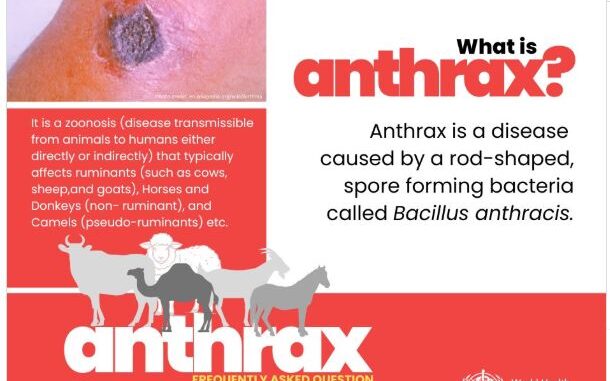
What is Anthrax?
- Anthrax is a zoonotic disease mainly affecting herbivores and domestic animals, with humans infected through animal contact.
- It is a rare but serious illness caused by Bacillus anthracis, a Gram-positive, spore-forming, non-motile bacterium found naturally in soil worldwide.
- Anthrax spores can survive for decades in the environment.
- Human infection occurs through skin contact, inhalation of spores, or gastrointestinal exposure from contaminated meat.
Why Anthrax is a Public Health Concern?
- Anthrax can cause serious illness and death in humans and animals.
- The spores of anthrax survive in soil for many years, making outbreaks hard to prevent.
- Humans can get infected through contact with animals, meat, or animal products.
- Anthrax outbreaks can lead to public health and economic problems in affected communities.
- It can be used in bioterrorism.
What are the Causes of Anthrax?
Bacillus anthracis: Structure and Spore Formation
- Anthrax is a serious infectious disease caused by the spore-forming, gram-positive bacterium Bacillus anthracis.
- It primarily affects livestock and wild herbivores, with human infection occurring through contact with infected animals, contaminated animal products, or by inhaling spores.
- anthracisis a large, rod-shaped Gram-positive bacterium that forms spores.
- Anthrax spores can persist in soil for decades in a dormant state.
- Once ingested, the spores are activated, and the bacteria begin to reproduce.
Virulence Factors and Anthrax Toxins
- Bacillus anthracis has two primary virulence factors:
- An extracellular poly-D-glutamate (D-PGA) capsule
- Anthrax toxin complex
- Protective antigen: It is bundung domain of anthrax toxin and is necessary for entry of the bacteria into the host cell.
- Lethal factor: It inactivates nitogen-activated protein kinase, leading to the inhibition of intracellular signaling.
- Edema factor: It acts by converting Adenosine triphosphate to cyclic adenosine monophosphate.
- These virulence factors are induced under physiologic conditions found in mammalian hosts, including:
- Body temperature (37 °C)
- Increased CO₂ levels
- Bicarbonate concentration
Types of Anthrax
1. Cutaneous Anthrax
- Most common form of anthrax
- Caused when spores enter through cuts or break in the skin from handling infected animals or products
- Usually appears on the head, neck, forearms, and hands
2. Inhalational Anthrax
- Severe form caused by breathing in spores
- Common in wool mills, slaughterhouses, or tanneries
- Can lead to serious respiratory illness
3. Gastrointestinal Anthrax
- Occurs from eating contaminated meat
- Symptoms include abdominal pain, vomiting, and diarrhoea
4. Injection Anthrax
- Happens from injecting contaminated drugs
- Causes severe soft-tissue infections
How Does Anthrax Transmit?
How Anthrax Spreads from Animals to Humans?
- Anthrax is usually spread in the form of a spore.
- Anthrax spreads to humans in three main ways:
- Skin contact: Touching contaminated animal products such as wool, hair, hide, bone, or skin
- Inhalation: Breathing in anthrax spores from contaminated materials
- Ingestion: Eating infected meat that is not properly cooked.
What are the Risk Factors of Anthrax?
Occupational Risk Groups for Anthrax
- Laboratory workers handling anthrax bacteria
- People working with animals or animal products like farmers, veterinarians, livestock workers
- People traveling to endemic areas
- Welders and metalworkers
- In case of bioterrorism:
- Mail handlers
- Military personnel
- Emergency and disaster response workers
Environmental Persistence of Anthrax Spores
- Anthrax spores can survive in soil for decades
- Spores resist heat, drying, and disinfectants
What are the Signs and Symptoms of Anthrax?
Clinical Features of Different Types of Anthrax
1. Cutaneous anthrax
- Cutaneous anthrax begins as a small red bump (papule) 5–7 days after spores enter through cuts or scrapes, usually on the hands, arms, neck, or face.
- The bump becomes a blister that may itch and eventually bursts, forming an open wound.
- The wound develops a black, hard scab (eschar), and more lesions may appear nearby
2. Gastrointestinal Anthrax
- In this type, you can get anthrax in your throat (oesophagus) or your stomach:
- Throat/oesophagus infection: trouble swallowing, sore throat, swelling of throat/neck, difficulty breathing
- Stomach/intestine infection: abdominal pain and swelling, diarrhoea (sometimes bloody), nausea, vomiting (sometimes bloody), malaise, red face and eyes
3. Inhalational Anthrax
In this type, symptoms occur in two phases;
- Phase 1 (Early / Flu-like symptoms):
- Fatigue
- Fever
- General malaise (feeling unwell)
- Phase 2 (Severe / Advanced symptoms):
- Chest pain
- Coughing, sometimes coughing blood (hemoptysis)
- Confusion
- Excessive sweating (diaphoresis)
- Fast, shallow breathing (tachypnea)
- Rapid heartbeat (tachycardia)
- Severe headache
- Nausea
- Trouble breathing (dyspnea)
4. Injection anthrax
- Injection anthrax is similar to cutaneous anthrax, but deeper.
- Early symptoms include:
- Bumps that might itch in the area of injection.
- Swelling around the sore.
What are the Complications Caused Due to Anthrax?
- Meningitis or meningoencephalitis – can occur from any form
- Sepsis – from any form
- Pleural effusion, pneumonia, or mediastinitis – mainly from inhalational anthrax
- Spreading skin infections like vasculitis, cellulitis – especially cutaneous or injection anthrax
- Stomach ulcers – from gastrointestinal anthrax
What are the Warning Signs Requiring Emergency Care?
- Black, painful skin sores that spread quickly
- Trouble breathing, chest pain, or coughing blood
- Severe stomach pain, vomiting, or diarrhoea
- Red, swollen, or infected injection sites
- High fever, confusion, or signs of serious infection
How is Anthrax Diagnosed?
- Anthrax is diagnosed by identifying Bacillus anthracis from clinical specimens and by detecting specific antibodies or bacterial DNA in the blood.
- Depending on which type of anthrax, the tests include:
- Cutaneous anthrax:
- Skin lesion swab or skin biopsy
- Gram stain
- Capsule staining
- Culture of lesion material
- PCR
- Inhalation anthrax:
- Chest X-ray or CT scan
- Blood culture
- PCR testing
- Gastrointestinal Anthrax
- Stool or blood culture
- PCR
- Serologic tests
- For all form of anthrax
- Lumbar Puncture,
- Blood test like PCR, ELISA
Challenges in Early Detection
- Because Early symptoms can look like common respiratory or stomach illnesses.
- Anthrax is rare, so healthcare workers may not suspect it at first.
- Low awareness among communities and healthcare providers can delay recognition.
What is the Treatment for Anthrax?
Antibiotic Therapy for Anthrax
- Anthrax is treated with antibiotics such as ciprofloxacin, doxycycline, or penicillin, which are most effective when given early.
- Antibiotics help kill Bacillus anthracis and prevent disease progression.
- Oral antibiotics are used for mild cases and post-exposure prophylaxis.
- Intravenous (IV) antibiotics are used in severe or systemic anthrax cases.
Role of Antitoxin and Supportive Care
- Antitoxin neutralizes circulating anthrax toxins, especially the protective antigen, and helps reduce toxin-mediated tissue damage.
- It improves survival in severe or systemic anthrax and is always used along with antibiotics, not alone.
- Supportive care includes continuous fluid drainage (such as pleural effusion drainage) to reduce breathing difficulty.
- Mechanical ventilation is provided in cases of respiratory failure to maintain adequate oxygenation.
Post-Exposure Prophylaxis (PEP)
- Given to individuals who have been exposed to anthrax but have no symptoms.
- Involves oral antibiotics for 60 days to prevent bacterial growth.
- Anthrax vaccine may be added in high-risk exposures for better protection.
What are the Prevention and Control Mechanisms for Anthrax?
Anthrax Vaccination: Uses and Effectiveness
- The anthrax vaccine (Anthrax Vaccine Adsorbed) is made from a laboratory-grown strain of Bacillus anthracis.
- It is highly effective (about 92.5%) in preventing infection.
- Recommended for adults 18–65 years at risk of exposure.
- Administered as 3 doses, followed by boosters for ongoing protection.
- Can be used before exposure for high-risk people and after exposure with antibiotics to prevent disease.
- Works by stimulating protective antibodies against anthrax.
Animal Vaccination and Veterinary Control
- Anthrax in animals is controlled through vaccination, early detection, reporting, quarantine, and treatment.
- The Sterne live vaccine is commonly used, given 2–4 weeks before outbreak season.
- Annual vaccination of grazing animals is recommended in endemic areas.
- During outbreaks: restrict movement, quarantine, and enforce emergency measures.
- Exposed animals may receive long-acting antibiotics, followed by vaccination after 7–10 days.
- Prompt disposal of carcasses by burning or deep burial is essential.
- Isolation of sick animals, disinfection, and good hygiene should be strictly maintained.
Infection Prevention and Control Measures
- Early detection and reporting of suspected human or animal cases.
- Isolation of infected or suspected cases and restriction of movement.
- Use of personal protective equipment (PPE) by healthcare workers, veterinarians, and handlers.
- Safely dispose of infected animals and products by burning or deep burial.
- Clean and disinfect contaminated areas and equipment.
- Provide post-exposure antibiotics to the exposed individual.
- Vaccination of animals and high-risk occupational groups where indicated.
- Environmental control, including control of insects and scavengers.
- Raise awareness about safe animal handling and meat consumption.
- Collaboration between human and animal health sectors (One Health) is essential.
Public Health and Biosecurity Related to Anthrax?
Anthrax Outbreaks and Case Studies
- Anthrax outbreaks continue to occur worldwide, especially in areas with low livestock vaccination coverage and close human–animal contact.
- Anthrax occurs more frequently in certain regions, including parts of South and Central America, Europe, Asia, Africa, the Caribbean, and the Middle East.
- In April 2025, an outbreak in Virunga National Park, Democratic Republic of the Congo, killed around 50 hippopotamuses and other wildlife, likely due to long-persisting spores in the soil.
- Between 1–4 May 2025, Thailand reported four confirmed cutaneous anthrax cases, including one death, following exposure during cattle slaughter.
Anthrax as a Bioterrorism Threat
- Anthrax (caused by Bacillus anthracis) is considered a high-priority bioterrorism agent because of its unique biological and epidemiological features.
- Occurs naturally but can be produced in laboratories.
- Forms spores that survive for long periods in the environment.
- Can be released secretly into the air, food, water, or mail.
- Airborne spread can infect many people at once.
- Even small amounts can cause large outbreaks.
Surveillance, Reporting, and Emergency Preparedness
Surveillance:
- Anthrax surveillance means regularly monitoring human and animal health to identify suspected cases early.
- It helps in early detection of outbreaks, especially in livestock, and reduces the spread of the disease to humans.
Reporting:
- Anthrax is a notifiable disease. If Bacillus anthracis is suspected or confirmed, it must be reported immediately to local or national public health authorities.
- Mandatory reporting helps authorities take quick control measures and protect the community.
Emergency Preparedness:
- Emergency preparedness for anthrax focuses on preventing human exposure, protecting healthcare and response workers, and detecting outbreaks as early as possible.
- This includes trained staff, proper laboratory facilities, availability of antibiotics and vaccines, and coordination between human and animal health sectors.
Frequently Asked Questions (FAQ’s)
Is Anthrax Contagious?
- Anthrax does not spread from person to person.
- Humans usually become infected through contact with infected animals, animal products, or spores in the environment.
Can Anthrax Be Treated Successfully?
- Anthrax can be treated successfully with antibiotics, especially when diagnosed and treated early.
Key Takeaway
- Anthrax is a serious zoonotic disease caused by Bacillus anthracis, affecting animals and humans.
- Transmission occurs through skin contact, inhalation, or eating contaminated meat.
- Anthrax does not spread from person to person.
- Antibiotics are essential for treating anthrax.
References and For More Information
- https://www.bcm.edu/departments/molecular-virology-and-microbiology/emerging-infections-and-biodefense/specific-agents/anthrax
- https://www.cdc.gov/anthrax/about/index.html
- https://www.usgs.gov/publications/persistence-time-lifespan-bacillus-anthracis-spores-environmental-reservoirs#:~:text=Upon%20host%20death%20Bacillus%20anthracis,exposure%20to%20large%20spore%20doses.
- https://www.health.ny.gov/diseases/communicable/anthrax/fact_sheet.htm#:~:text=How%20is%20anthrax%20spread%3F&text=Skin%20(cutaneous)%20%2D%20Most%20anthrax,wool%2C%20bone%2C%20hair%20and%20hide.
- https://www.cdc.gov/anthrax/prevention/occupational-exposure.html
- https://my.clevelandclinic.org/health/diseases/10853-anthrax
- https://www.mayoclinic.org/diseases-conditions/anthrax/symptoms-causes/syc-20356203
- https://www.ebsco.com/research-starters/health-and-medicine/anthrax-vaccine
- https://www.chop.edu/vaccine-education-center/vaccine-details/anthrax-vaccine#:~:text=At%20least%2095%20of%20100,against%20anthrax%20in%20their%20blood.
- https://www.msdvetmanual.com/infectious-diseases/anthrax/anthrax-in-animals#Treatment,-Control,-and-Prevention_v3271960
- https://www.cdc.gov/anthrax/bioterrorism/index.html
- https://www.gov.nt.ca/ecc/sites/ecc/files/file_reports/139_file.pdf
- https://moh.gov.bt/wp-content/uploads/2025/01/Anthrax-Guideline-2013.pdf#:~:text=Therefore%2C%20a%20comprehensive%20guideline%20for,Bhutan%20through%20’One%20Health’%20approach.
- https://www.who.int/emergencies/disease-outbreak-news/item/2025-DON573#:~:text=Description%20of%20the%20situation,slaughtered%20on%2028%20April%202025.
