Table of Contents
What is Plague?
- Plague is a communicable disease that affects rodents, as well as some animals and humans, caused by the bacterium Yersinia pestis.
- Although plague is now rare and treatable, it remains a public health concern in certain regions and can be fatal if diagnosis is delayed.
History of Plague: Black Death and Modern Outbreaks
- Historically, plague is an ancient infectious disease responsible for widespread pandemics with very high mortality.
- It occurred in three major pandemics: the Justinian Plague (6th century), the Black Death (14th century), and the Third Pandemic (19th–20th century), spreading across continents through trade and migration.
- The Black Death was the most devastating, causing over 50 million deaths in Europe and killing nearly one-third of the population, with profound social and economic impacts.
- In the modern era, plague is rare and treatable with antibiotics, though sporadic outbreaks still occur in certain regions.
What are the Different Types of Plague?
There are 3 types of plague:
1. Bubonic Plague
- Starts with sudden fever, headache, and body pain, followed by painful swollen lymph nodes (buboes), usually in the groin, armpit, or neck.
- If not treated early, it can quickly spread to the blood and lungs, leading to severe illness and high risk of death.
2. Septicaemic Plague
- Septicaemic plague occurs when the bacteria enter the bloodstream.
- It may develop from bubonic plague or occur without swollen lymph nodes.
- It can cause blood infection, shock, bleeding problems, organ failure, and meningitis, and is often life-threatening.
3. Pneumonic Plague
- The most serious and deadliest form of plague. It affects the lungs and can spread through the air from person to person.
- Symptoms include high fever, breathing difficulty, chest pain, and coughing up blood.
- “Mortality is extremely high without early antibiotic treatment” Thus, treatment must be done within 18–24 hours.
What Causes Plague?
- Plague is an infectious disease caused by the bacterium Yersinia pestis.
How Does Plague Transmit?

How Does Plague Spread from Animals to Humans?
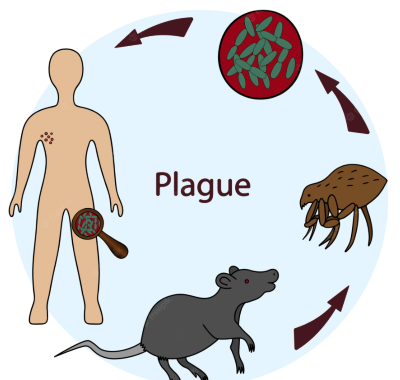
- Plague mainly affects rodents (such as rats), while humans are infected accidentally.
- The most common way humans get plague is through the bite of infected fleas that feed on rodents.
- Less commonly, plague can spread by handling infected animal tissues or by breathing droplets from a person or animal with pneumonic plague.
Role of Fleas, Rodents, and Wildlife
- Plague mainly spreads among rodents through a cycle involving fleas, which pick up the bacteria when they bite infected animals.
- Fleas can then transmit the bacteria to humans or other animals through bites.
- Wildlife can also carry the bacteria, helping maintain the disease in nature and increasing the chance of human infection, especially in rural or forested areas.
What are the Different Signs & Symptoms of Plague?
Early Signs and Symptoms
- Fever and chills
- Headache and body aches
- Weakness and fatigue
- Dizziness, nausea, vomiting, and diarrhoea
Symptoms: By Type
- Bubonic plague: Swollen, tender lymph nodes (buboes) in the armpits, groin, or neck; fever, headache, fatigue.
- Septicemic plague: Infection in the bloodstream; causes fever, fatigue, abdominal pain, and internal bleeding (nose, mouth, or under the skin).
- Pneumonic plague: Affects the lungs, causes fever, shortness of breath, chest pain, cough, and bloody or watery mucus; can also lead to weakness, insomnia, stupor, and memory loss.
When to Seek Medical Attention?
- Immediate medical attention should be sought if a person develops sudden fever, chills, or swollen lymph nodes after possible exposure to rodents, fleas, or infected animals.
How Is Plague Diagnosed?
- Diagnosis is usually based on medical history, symptoms, and possible exposure to infected animals or fleas.
- Confirmation of plague still requires laboratory testing, ideally by detecting Yersinia pestis in pus from a bubo, blood, or sputum.
- A rapid dipstick test is now widely used in Africa and South America with WHO support for quick screening of plague.
Laboratory Tests for Plague Confirmation
- Microscopy: Smears from lymph node fluid, blood, or sputum can be stained with Gram, Wright, Giemsa, or Wayson stains. Yersinia pestis appears as small Gram-negative rods with bipolar “safety pin” staining, which raises suspicion of plague.
- Blood culture: A sensitive method to isolate Y. pestis. If negative but plague is still suspected, serologic testing can be done using an early serum sample and a follow-up sample 4–6 weeks later.
- Lymph node aspirate: Buboes usually contain many bacteria, which can be examined by microscopy and culture.
- Respiratory specimens: In pneumonic plague, bacteria can be cultured from sputum, though blood cultures are often positive too.
- Biopsy or autopsy: Tissue from lymph nodes, spleen, lungs, or liver can be cultured to confirm infection.
Differential Diagnosis
- Tularaemia
- Streptococcal or staphylococcal lymphadenitis
- Infectious mononucleosis
What can Plague be Treated?
Antibiotic Treatment
- Antibiotics and supportive therapy are effective against plague if patients are diagnosed in time.
- Antibiotics that may be used include the following:
- Doxycycline
- Ciprofloxacin
- Levofloxacin
- Moxifloxacin
- Chloramphenicol
Why Early Treatment is Critical?
- Untreated plague can be rapidly fatal, so early diagnosis and treatment is essential for survival and reduction of complications.
How can we Manage the Outbreaks of Plague?
- Identify and stop the source of infection
- Follow infection prevention and control measures
- Control vectors first, then rodents
- Protect health workers with Personal Protective Equipment (PPE) and antibiotics
- Treat patients with proper antibiotics
- Isolate pneumonic cases and provide masks
- Monitor contacts and give preventive antibiotics
- Collect samples safely for testing
- Maintain hygiene, disinfection, and safe burial practices
How can we Prevent Plague Infection?
- Use insect repellents containing DEET to prevent flea bites.
- Consult a veterinarian about effective flea prevention for pets, as dogs and cats can carry plague-infected fleas.
- Wear protective gloves when handling animals, whether alive or dead, that may be infected.
- In plague-affected areas, keep pets indoors and do not allow them to roam freely outside.
How can we Control Plague in Endemic Areas?
- Early case detection and prompt treatment
- Vector (flea) control followed by rodent control
- Community awareness and surveillance
- Environmental sanitation and safe housing
What are the Different Infection Prevention and Control (IPC) Measures?
- Use of Personla Protective Equipments (PPE) by health workers
- Hand hygiene and surface disinfection
- Safe specimen handling and burial practices
Frequently Asked Questions (FAQs)
Is Plague Curable Today?
- Plague is curable with early diagnosis and appropriate antibiotics.
Can Plague Spread from Person to Person?
- Pneumonic plague can spread through respiratory droplets.
Why Is Plague Still Relevant in Public Health?
- It persists in endemic areas, can cause outbreaks, and may lead to severe illness or death if not treated early.
References and For More Information
- https://www.who.int/news-room/fact-sheets/detail/plague
- https://www.britannica.com/science/plague/History
- https://www.cda.gov.sg/professionals/diseases/plague/
- https://www.britannica.com/science/plague
- https://www.cdc.gov/plague/hcp/diagnosistesting/index.html#:~:text=Recommended%20tests%20for%20plague%20include:%20*%20Microscopic,pain%20*%20Pharyngeal%2C%20meningeal%2C%20and%20cutaneous%20forms
- https://my.clevelandclinic.org/health/diseases/17782-plague
- https://www.mayoclinic.org/diseases-conditions/plague/diagnosis-treatment/drc-20351297
- https://www.who.int/news-room/fact-sheets/detail/plague
- https://www.cdc.gov/plague/causes/index.html
- https://www.chp.gov.hk/en/healthtopics/content/24/3028.html
- https://emedicine.medscape.com/article/235627-overview
- https://pmc.ncbi.nlm.nih.gov/articles/PMC7149940/
- https://www.pasteur.fr/en/medical-center/disease-sheets/plague
- https://dph.illinois.gov/topics-services/emergency-preparedness-response/public-health-care-system-preparedness/plague.html
