Table of Contents
What is Botulism?
- Botulism is a rare but serious bacterial disease caused by a neurotoxin produced by the rod-shaped bacteria Clostridium botulinum.
- Botulism affects the nervous system and can lead to severe illness, difficulty breathing, paralysis and even death.
- Clostridium botulinum produces seven toxin types (A–G), but only types A, B, E, and F are known to cause disease in humans.
Why is Botulism a Medical Emergency?
- Botulism is considered a medical emergency because the bacteria produce a powerful toxin that attacks the nervous system.
- This toxin can cause muscle weakness, paralysis, difficulty in breathing, and may lead to death if not treated promptly.
What are the Causes & Pathogens of Botulism?
- Botulism is caused by a spore-forming bacterium called Clostridium botulinum.
- Infection usually occurs through contaminated food or wounds, where the bacteria produce toxins.
- The bacteria form spores that can survive in extreme environmental conditions.
- These spores are usually inactive, but they can grow and produce toxins under the following conditions:
- Low or no oxygen (anaerobic environment)
- Low acid
- Low sugar
- Low salt
- Suitable temperature range
- Adequate moisture (water)
What are the Different Types of Botulism?
Basically, there are five different types of botulism. They are:
1. Foodborne Botulism
- Foodborne botulism occurs when a person eats food contaminated with botulinum toxin.
- The toxin is commonly found in improperly preserved, fermented, or canned foods, where Clostridium botulinum spores can grow and produce toxin in the absence of oxygen.
2. Infant Botulism
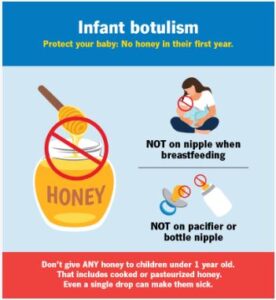
- Infant botulism occurs when infants ingest Clostridium botulinum spores from contaminated soil or food.
- These spores germinate in the intestines and release toxins. It mainly affects infants under 6 months of age.
- Most reported cases are linked to feeding honey, which may contain the spores.
3. Wound Botulism
- Wound botulism is a rare form of botulism. It occurs when Clostridium botulinum spores enter an open wound and multiply in an anaerobic environment, producing toxins.
4. Iatrogenic Botulism
- Iatrogenic botulism is caused by the excessive or improper use of botulinum toxin for cosmetic or medical purposes, such as Botox injections.
5. Inhalational Botulism
- Inhalational botulism occurs when botulinum toxin is inhaled, usually in laboratory or bioterrorism-related settings. This type is extremely rare.
What are the Transmission and Risk Factors of Botulism?
- By consuming foods contaminated with botulinum toxin, especially improperly canned, preserved, or fermented foods
- Through wound contamination, when Clostridium botulinum infects open cuts and produces toxin
- In infants, by ingesting spores (e.g., from honey or soil) that grow and produce toxin in the intestine
- By environmental exposure to soil or dust containing botulinum spores (mainly a risk for infants and wounds)
- Rarely, due to overdose or improper use of botulinum toxin in medical or cosmetic procedures.
Common Sources of Botulinum Toxin
- Improperly home-canned foods
- Fermented or preserved foods stored without enough salt or acid
- Vacuum-packed or airtight foods
- Contaminated honey (especially for infants)
- Soil and dust containing spores
- Contaminated wounds
- Excessive botulinum toxin injections
Risk Factors for Botulism Infection
- People who eat improperly canned, preserved, or fermented foods
- A person being injected with too much toxin
- People who use injection drugs
- Infants below 6 (six) months fed with honey
- Persons who receive a very high dose of botulinum toxin for cosmetic purposes
What are the Different Signs and Symptoms of Botulism?
Early Symptoms of Botulism
Early symptoms include:
- marked fatigue
- weakness and vertigo
- blurred vision
- dry mouth
- difficulty in swallowing and speaking
- vomiting
- diarrhoea
- constipation
- abdominal swelling
Neurological Signs and Progressive Paralysis
- Botulinum toxins are potent neurotoxins that affect the nervous system
- Botulism causes prolonged flaccid paralysis, lasting weeks to months
- Early symptoms are followed by progressive muscle weakness
- Weakness typically begins in the head, neck, and arms
- Paralysis then spreads to the respiratory muscles, leading to breathing difficulty
- Lower limb muscles are affected later, impairing movement
Symptoms of Botulism in Infants
Symptoms in infants include:
- Difficulty or choking during feeding
- Constipation (often the first symptom)
- Weak suck or poor feeding
- Drooping eyelids (ptosis)
- Reduced facial expressions
- Difficulty lifting the head
- Weak or soft cry
- Reduced movement
How is Botulism Diagnosed?
Botulism is diagnosed through:
- Clinical Evaluation: Examining signs and symptoms
- Laboratory Tests: Laboratory confirmation is done by culture, polymerase chain reaction (PCR) or demonstrating the presence of botulinum toxin in serum, stool or wound.
Differential Diagnosis of Acute Paralysis
- Guillain–Barré syndrome (GBS)
- Myasthenia gravis
- Stroke
- Poliomyelitis
- Tick paralysis
- Acute spinal cord disorders
What is the Treatment of Botulism?
Botulinum Antitoxin: Role and Timing
- Botulinum antitoxin is the only specific treatment available
- The antitoxin should be given as early as possible once botulism is clinically suspected, to prevent further toxin action
- Most effective if given within 24 hours, and up to 48 hours of symptom onset
- Early administration is effective in reducing mortality rates.
- Works by binding toxin in the bloodstream and preventing nerve damage.
- Adult dose: one vial given intravenously
- Paediatric dose: based on body weight
Supportive Care and Mechanical Ventilation
- Severe cases of botulism require intensive supportive care, with mechanical ventilation often needed to maintain breathing
- Ventilatory support may be required for several weeks, depending on the severity of paralysis
- Most patients survive with proper supportive care, even without antitoxin
Antibiotics in Wound Botulism
- Antibiotics are useful only in wound botulism
- Treatment includes:
- Appropriate antibiotic therapy
- Thorough cleaning (debridement) of the wound
What are the Prevention and Control Mechanisms of Botulism?
Food Safety Measures to Prevent Botulism:
- Do not eat food from cans or jars that are swollen, leaking, damaged, or look strange.
- Do not eat food if liquid or foam comes out when opening the can.
- Keep opened canned food in the fridge if not eaten immediately.
- Keep food hot (above 60°C) if you plan to eat it later.
- Keep raw food and cooked food separate.
- Boil home-canned food for 10 minutes before eating.
Infant Botulism Prevention Strategies
- The main way to prevent infant botulism is not to give honey to a child under 1 year of age.
Public Health Response to Botulism Cases
- Laboratories and hospitals must report botulism cases to the local Public Health Unit.
- Rapid investigation is done to find the source of infection.
- Public awareness programs are conducted on safe food handling and proper canning practices.
Public Health Perspective on Botulism
Epidemiology of Botulism Worldwide
- The incidence of botulism is low, but it is a life-threatening disease.
- The mortality rate is high if botulism is not diagnosed early.
Table: Top Five Countries Reporting Human Botulism Outbreaks (2017–2024)
Between 2017 and 2024, Ukraine had the most outbreaks.
| Country | Outbreaks |
| Ukraine | 145 (56%) |
| Russian Federation | 28 (10.8%) |
| United States of America | 18 (7%) |
| Romania | 11 (4.3%) |
| Italy | 8 (3.1%) |
Source: ScienceDirect article
Botulism as a Potential Bioterrorism Agent
- Botulinum toxin is one of the most powerful toxins known.
- It can be misused intentionally to cause large outbreaks.
- Considered a high-risk biological weapon by public health authorities.
- An attack could release botulinum toxin into the food supply or air. Many people could get sick.
Surveillance and Reporting Systems
- Botulism is a notifiable disease in many countries.
- Hospitals and laboratories must report cases to public health authorities.
- Surveillance helps:
- Detect outbreaks early
- Identify the source of infection
- Prevent further cases
Frequently Asked Questions (FAQs)
Is Botulism Curable?
- Yes, botulism can be treated. Early administration of botulinum antitoxin and proper supportive care, including respiratory support, can save lives.
How Fast Do Botulism Symptoms Appear?
- Symptoms usually appear within 12–36 hours after eating contaminated food, but sometimes it can take a few hours to several days depending on the type of botulism.
Can Botulism Be Prevented?
- Botulism is usually preventable with the right precautions, especially the foodborne type.
Key Takeaway
- Causes flaccid paralysis by blocking nerve–muscle transmission
- Not spread person to person
- Common sources include improperly preserved foods, wound contamination, and honey in infants
- Early diagnosis and antitoxin treatment are life-saving
References and For More Information
- https://my.clevelandclinic.org/health/diseases/17828-botulism
- https://www.cdc.gov/botulism/about/index.html
- https://www.mayoclinic.org/diseases-conditions/botulism/symptoms-causes/syc-20370262
- https://www.who.int/news-room/fact-sheets/detail/botulism
- https://www.ncbi.nlm.nih.gov/books/NBK459273/
- https://www.cda.gov.sg/public/diseases/botulism/
- https://www.chp.gov.hk/en/healthtopics/content/24/44865.html
- https://my.clevelandclinic.org/health/diseases/infant-botulism
- https://pmc.ncbi.nlm.nih.gov/articles/PMC8112830/#sec27
- https://emedicine.medscape.com/article/213311-medication#2
- https://www.cda.gov.sg/public/diseases/botulism/
- https://journals.lww.com/jpcr/fulltext/2015/02030/acute_flaccid_paralysis.6.aspx#:~:text=The%20common%20differential%20diagnoses%20in,in%20the%20appropriate%20clinical%20setting.
- https://www.sciencedirect.com/science/article/pii/S0735675725007958#:~:text=Botulism%20outbreaks%20were%20reported%20most,and%20animals%2C%202017%E2%80%932024.&text=*Of%20the%20259%20Outbreaks%20in,=%200.14;%20Table%20S2).
- https://www.fsis.usda.gov/food-safety/foodborne-illness-and-disease/illnesses-and-pathogens/botulism#:~:text=Botulism%20is%20a%20life%2Dthreatening%20disease,of%20the%20C.%20botulinum%20bacteria
