
- Genetically modified (GM) foods are foods produced from plants or animals whose DNA has been altered through genetic engineering.
- These foods (plants or animals) are obtained by DNA manipulation of those plants or animals in such a way which cannot be obtained by mating and/or natural recombination
- Foods produced from Genetically Modified Organisms (GMO) are called GM foods.
- GM foods are also known as genetically engineered foods or bio-engineered foods.
- The technology is often called “modern biotechnology” or “gene technology”, sometimes also “recombinant DNA technology” or “genetic engineering”
- GM foods are produced because they are important either for producers or the consumers
- Primarily, crops are modified for protection and resistance against plant disease.
- Currently, GM foods stem mostly from plants. However, in future foods derived from GM microorganisms or GM animals are likely to be introduced
- 85% of the corn, 91% soybeans, cotton seeds etc. used in USA are genetically modified
- GMOs are present in 80% of the processed foods.
- GM foods doesn’t necessarily have to be new organisms. It can be selective change in the older ones.
- Besides, foods, vaccines, fibers, feeds, etc., are obtained by this method
- The very first GM food to be commercially sold was the FlavrSavr tomato from California.
Table of Contents
Examples of GM foods present in the world:
- Cotton
- Rice
- Soybean
- Sugar cane
- Brinjal
- Tomatoes
- Sweet corn
- Canola
- Potato
- Papaya
- Sugar beet
Advantages of GM food:
- GM crops are disease and pest resistant i.e. more yielding and more profit.
- These foods are insect resistant. It reduces the cost and effort for spraying insecticides.
- Genetic modification is necessary to increase food supply to the growing population as the crop yields from GM organisms/plants are consistent and more productive.
- It has increased taste, quality and nutrients.
- Genetic engineering can be used to add nutrient on the staple food. Thus, such food provides added nutritional value.
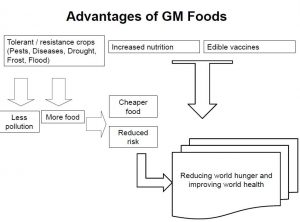
- GM is useful for food fortification which increases the nutritional quality of food.
- It has less maturation time i.e. it grows faster, thus more profit can be earned in short time.
- GM foods have longer shelf lives which decreases the rely on the preservatives to maintain freshness of foods.
- Most of these foods have herbicide tolerance traits.
- Stress tolerance:
- Drought resistance crops
- Salt-tolerant crops
- Frost resistant crops
- Flood resistant crops
- Development of crops that make more efficient use of nitrogen and other nutrients.
- GM foods being more resistant and having more shelf life can be safely transported to distant places.
- GM foods are able to withstand any temperature and can survive without the use of pesticides. Thus, it can be grown easily.
- With genetic engineering, farmers will have more income which will further help them in improving their living standards.
- Less chemicals, time, machinery and land are needed for GM crops and animals which can help reduce environmental pollution, green house gas emissions and soil erosion.
Limitations:
- There have not been enough studies to ensure that GM foods are safe in the long run. long-term effects of eating GMO foods has not been studied because the technology is not old enough to produce data.
a) Effects on health
- Some foods are developed with the resistant gene to protect from the disease. Regular consumption of such food exposes us to the antibiotics and can cause antibiotic resistance.
- GM foods might cause new diseases.
- Increase in the number of the allergies.
- In 1996, Brazil nut genes were transferred into soybeans by a company called Pioneer Hi-Bred. Some individuals, however, are so allergic to this nut, they went into anaphylactic shock which can cause death.
- GM food are often linked to have increased toxicity. Such foods are also considered as carcinogenic.
b) Effects on environment
- Genetic modification of foods is an interruption to the natural evolution process
- Insertion of the foreign gene can alter the original ones and can also produce unsuitable outcomes
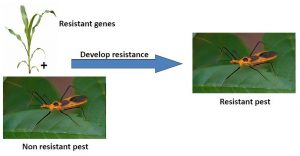
- There is always an increased chance of cross pollination between modified plant and non-modified plant. This leads to the transfer of the selective trait to the other plant as well. Along with the selected plants, weeds could turn resistant as well.
- Pollen from modified plants can spreads and will infect other plants, creating “superweeds” with insecticidal properties or herbicide -resistance.
- GM foods can cause harm to the other creatures (For example: the pollen of Bt. Corn caused high mortality in monarch butterfly caterpillars) affecting the biodiversity.
- Improved crops decrease the pests in the crop which are actually the diet for many birds and insects thereby decreasing their food and increasing the difficulty in their survival.
Controversies related to GM foods:
- No test conducted
- Increased yields
- Impact on human health
- Bio safety concerns
- Bio diversity concerns
- Cost effective
- Insect resistant
- Reduce use of insecticides
References and for More Information:
https://www.vox.com/cards/genetically-modified-foods/what-is-genetically-modified-food
https://www.huffingtonpost.com/builtlean/diet-and-nutrition_b_4323937.html
http://www.who.int/foodsafety/areas_work/food-technology/faq-genetically-modified-food/en/
https://www.disabled-world.com/fitness/gm-foods.php
https://www.scq.ubc.ca/genetically-modified-foods/
https://vittana.org/12-advantages-and-disadvantages-of-genetically-modified-foods
https://connectusfund.org/27-big-advantages-and-disadvantages-of-genetically-modified-foods
https://thenextgalaxy.com/disadvantages-and-advantages-of-genetically-modified-crops/
http://www.vib.be/en/news/Documents/vib_fact_genetisch%20gewijzigde%20gewassen_ENG_2016_LR.pdf
https://blogs.umass.edu/natsci397a-eross/effects-of-genetically-modified-crops-on-the-environment/
https://www.ncbi.nlm.nih.gov/pmc/articles/PMC3791249/
https://www.researchgate.net/publication/293731204_Impact_of_GMO’S_on_environment_and_human_health
https://www.onegreenplanet.org/environment/how-do-gmos-impact-people-and-the-environment/
https://www.youtube.com/watch?v=mz4_TwdaYeI
