
Table of Contents
Why to invest on Nutrition?
- Malnutrition decreases GDP by 3-7 % (up to 11%) – [World Bank 2005]
- Investment of Rs 1= return of Rs 16 which is a lifetime satisfying results [Global Nutrition Report, 2016]
- NO UPGRADE from Least Developed Countries without improvement in nutrition
- Undernutrition/stunting under 2 years is an indicator of a comprehensive Human Capital.
- At a micro-economic level, it is calculated that 1 percent loss in adult height as a result of childhood stunting equals to a 1.4 percent loss in productivity of the individual
- The loss from stunting is calculated as 1.38% reduced for every 1% drop in iron status (source Haddad and Bouis, 1990).
- All forms of malnutrition cost the global economy an estimated $3.5 trillion per year, or $500 per individual (Global Panel 2016)

- Therefore, to reduce under nutrition and improve results of investment in nutrition, awareness on nutrition is necessary and it should be prioritized.
What is Malnutrition?
- Malnutrition refers to the imbalance in the intake of energy and nutrition.
- It is the imbalance between what our body needs and what we eat.
- It refers to both deficiency and excess of the nutrition
- Malnutrition is the result of the less intake or mal-absorption of nutrient by the body
- Under nutrition puts children at the greater risk of dying.
Malnutrition and other economic consequences:
- Nutrition is key to healthy life, economy and survival.
- A child’s height-for-age predicts adult cognitive achievement and productivity
- Malnutrition slows down the economic growth and leads to poverty.
- Morbidity and mortality linked with the malnutrition denotes the loss of human capital.
- Under nutrition in young age also makes people prone to the non-communicable disease in later stages of life thereby increasing the expenditure on the health and increasing the burden.
- Moreover, intrauterine growth retardation, low birth weight, and premature birth have a causal relationship to the origins of hypertension, coronary heart disease, and non-insulin-dependent diabetes, in middle age of life (Barker Hypothesis).
- They have poor intellectual ability and memory power which makes them difficult in performing better in school and college studies. It ultimately creates gaps between educated and non-educated; and skilled and non-skilled human resource.
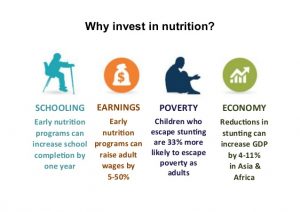
- Malnutrition prevents one from reaching the full potential in all forms; physically, mentally, psychologically and socially.
- Poorly nourished citizens are also loss for the country as the country cannot expect a lot from them and moreover have to invest heavily for their health and well-being.
Effects of malnutrition on health and survival:
- Undernutrition leads to physical as well as cognitive stunting
- It makes one more susceptible to disease
- Micronutrient deficiencies causes severe illness and even leads to physical impairments
- Overweight and obesity increases the risk of NCDs such as diabetes, cardiovascular diseases, etc.
- Maternal malnutrition increases the risk of poor pregnancy outcomes like premature delivery, low birth weight, postpartum hemorrhage, and even maternal mortality
- Malnutrition is also the cause for the disability
What do we understand by productivity?
- Productivity is defined as the ratio of output to input
- It refers to how efficiently inputs such as capital, labor or other resources are used for achieving the given output.
Malnutrition, economic productivity, and human health linked with each other:
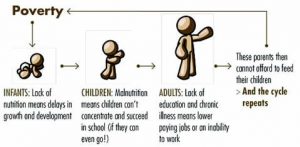
- Connected with each other.
- One leads to the other and is never ending loop.
- Malnutrition at young age makes one susceptible to various kind of disease.
- Malnourished children = malnourished adult.
- Young malnourished adult cannot develop their full potential.
- Lack of proper education, skills reduces their economic productivity.
- Further pushes towards the poverty.
- Basic needs along with health services becomes challenge further declining the state of health.
- Malnourishment in the young female leads to maternal complication and the low birthweight babies.
- Such babies are more susceptible to stunting and other forms of malnutrition.
- This again continues in loop.
- Furthermore, poverty or say financial constraints is considered as the one of the factors for the malnutrition.
- Poor nutrition in childhood is associated to the reduced earning in adulthood.
References and for More Information:
http://www.oecd.org/sdd/productivity-stats/40526851.pdf
http://www.europarl.europa.eu/meetdocs/2009_2014/documents/acp/dv/background_/background_en.pdf
http://www.fao.org/zhc/detail-events/en/c/238389/
http://motherchildnutrition.org/malnutrition/about-malnutrition/impact-of-malnutrition.html
https://www.researchgate.net/publication/242101651_8_Nutrition_Malnutrition_and_Economic_Growth
https://www.ncbi.nlm.nih.gov/pmc/articles/PMC1839860/
https://www.ncbi.nlm.nih.gov/pmc/articles/PMC3023144
https://data.unicef.org/topic/nutrition/malnutrition/
https://emedicine.medscape.com/article/985140-overview
https://www.medicalnewstoday.com/articles/179316.php
http://www.who.int/features/qa/malnutrition/en/
https://www.medicalnewstoday.com/articles/179316.php
