Table of Contents
What is Diphtheria?
- Diphtheria is a serious bacterial disease that mainly affects the lining of the nose and throat, caused by Corynebacterium diphtheria.
- Diphtheria is a highly contagious illness caused by bacteria that produce harmful toxins.
- The infection spreads through respiratory droplets released when an infected person coughs or sneezes.
- Diphtheria can affect anyone, but it is most common in unvaccinated children.
Why is Diphtheria Still a Public Health Concern?
- Easy transmission through respiratory droplets, close contact, and overcrowded living conditions leads to rapid spread.
- Low immunization coverage allows diphtheria to persist, especially among unvaccinated populations.
- Weak healthcare and surveillance systems cause delayed diagnosis and increased complications.
- Continued outbreaks in developing countries reflect poor vaccination uptake and limited health system capacity.
What are the Causes of Diphtheria?
- Diphtheria is a serious infection caused by strains of the bacterium called Corynebacterium diphtheriae, a Gram-positive bacillus, which makes a toxin.
How Diphtheria Toxins Affect the Body?
- Diphtheria toxins stop protein production in cells, causing them to die.
- It forms a thick grey membrane in the throat, making breathing and swallowing difficult.
- If the toxin spreads in the blood, it can damage the heart (myocarditis).
- It can affect the nervous system, causing weakness or paralysis.
How Does Diphtheria Spread?
- Through respiratory droplets: When an infected person coughs or sneezes, nearby people may inhale the bacteria. Spread is easier in crowded places.
- Through contaminated objects: Touching items used by an infected person (like tissues, towels, or open sores) can transmit the bacteria.
- Through close contact risk: Household members or people who have frequent contact with an infected person are at higher risk.
What are the Risk Factors of Diphtheria?
- Lack of vaccination: Unvaccinated or not up-to-date on vaccinations (children and adults)
- Age factor: Under 5 years or over 40 years
- Crowded or unsanitary living conditions
- Low herd immunity in the community
- Weakened immune system
- Travel to areas where diphtheria is common
- Living or working in overcrowded places
What is the Incubation Period of Diphtheria?
The incubation period is usually 2–5 days, but it can range from 1 to 10 days.
What are the Symptoms of Diphtheria?
Early Symptoms of Diphtheria
1. Respiratory Diptheria
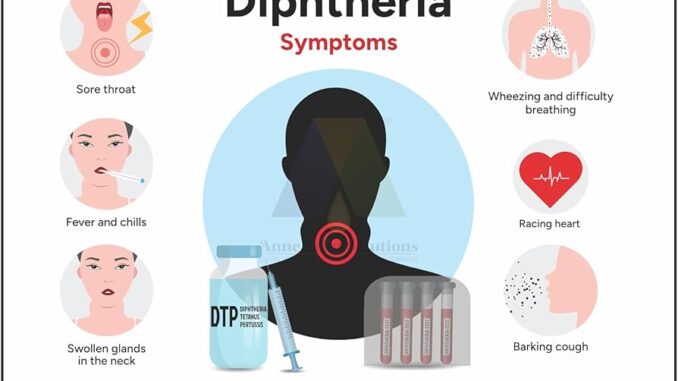
- Sore throat and pain
- Weakness or fatigue
- Mild fever
- Swollen neck lymph nodes
- Thick grey coating in the throat
- Difficulty breathing or swallowing
2. Cutaneous Diptheria
- Painful open sores or ulcers
- Rash with scaling or peeling skin
- Swelling and discoloration around the affected area
3. Classic Pseudomembrane Formation in the Throat
- Caused by diphtheria toxin, killing cells in the throat.
- Forms a thick, grayish-white layer made of dead cells, bacteria, and mucus.
- Can block the airway, leading to respiratory failure and death.
What are the Complications of Diphtheria?
- Breathing problems
- Heart Damage
- Nerve Damage
- Kidney failure
How Can Diphtheria be Diagnosed?
Clinical Examination
Healthcare providers diagnose diphtheria based on your symptoms, such as sore throat, fever, swollen neck, and thick grey pseudomembrane in the throat.
Laboratory tests:
- Throat Culture
- Polymerase Chain Reaction (PCR)
- Serology Test
- Toxin Detection Test
- Gram Stain
- Laryngoscopy
- Nasopharyngeal Swab
What is the Importance of Early Diagnosis in Diphtheria?
- Early Diagnosis prevents severe complications and death by allowing timely antitoxin and antibiotic treatment.
- It reduces the spread of infection and helps control outbreaks in the community.
What are the Treatment Measures of Diphtheria?
Diphtheria Antitoxin: Role and Importance
- Diphtheria Antitoxin (DAT) is an equine serum product and is the gold standard treatment for diphtheria.
- It should be administered immediately to probable respiratory diphtheria cases
- DAT is used to prevent and treat diphtheria in exposed or infected individuals.
- It reduces mortality and morbidity by neutralizing circulating diphtheria toxin.
- It reduces disease severity and complications, particularly cardiac and neurological damage.
Antibiotic Treatment for Diphtheria
- Treatment includes antibiotics to kill Corynebacterium diphtheriae and diphtheria antitoxin to neutralize the toxin.
- Only erythromycin or penicillin is recommended as antibiotic therapy.
What are the Supportive Care and Isolation Measures for Diphtheria?
- Airway management to prevent or treat obstruction due to pseudomembrane.
- Monitoring of heart and nerve function for complications.
- Strict isolation of patients to prevent spread of infection.
- Good hygiene and infection control practices for caregivers and contacts.
- Minimize frequent examinations and invasive procedures to avoid unnecessary disturbance of the child.
What are the Prevention and Control Measures for Diphtheria?
Vaccination- Best and Key Strategy
Diphtheria Vaccine (DPT/DTaP): Schedule and Effectiveness
- The diphtheria vaccine is commonly given in combination vaccines with tetanus, pertussis, Haemophilus influenzae type b, hepatitis B, and inactivated polio.
WHO Recommendation
- Primary series:
- 3 doses starting at 6 weeks of age
- Minimum 4-week interval between doses
- Booster doses (3):
- 12–23 months (second year of life)
- 4–7 years
- 9–15 years
- At least 4 years between booster doses is recommended for long-term protection.
DTaP Vaccination Schedule (5-Dose Series)
- 2 months
- 4 months
- 6 months
- 15–18 months
- 4–6 years
- National immunization schedules may vary slightly.
- Like all vaccines, it may cause mild side effects (such as pain at the injection site or low-grade fever), which usually resolve on their own.
- Vaccines are 95% effective against diphtheria.
Role of Herd Immunity
- To achieve herd immunity against diphtheria, vaccine coverage of 80%–85% of the population must be maintained.
- Maintaining this coverage reduces the risk of outbreaks and protects those who are unvaccinated or vulnerable.
Outbreak Control and Contact Management
- Suspected cases should be identified quickly and isolated to prevent transmission.
- Monitor contacts for symptoms for at least 7–10 days.
- Administer antibiotics (usually erythromycin or penicillin) to close contacts to prevent disease.
- Ensure contacts are up-to-date on diphtheria vaccination; provide booster doses if needed.
- Report all cases to public health authorities.
- Monitor trends to detect and respond to new cases promptly.
- Increase awareness about hygiene and respiratory etiquette.
Public Health Perspective
What is the Epidemiology of Diphtheria in Developing Countries?
- Globally, clinical diphtheria is increasing, predominantly affecting developing countries, where it remains a significant cause of morbidity and mortality.
- Crowded living conditions, low socioeconomic status, cultural beliefs, and the importation of microorganisms further contribute to the occurrence of large-scale outbreaks.
- Periodic outbreaks continue to occur, particularly in regions with disrupted vaccination programs.
Diphtheria Resurgence and Vaccine Hesitancy
- Despite proven vaccine effectiveness, diphtheria has resurged due to vaccine hesitancy and reduced immunization coverage.
- Misinformation, cultural beliefs, fear of side effects, and low trust in health systems contribute to vaccine refusal or delay.
- The re-emergence of diphtheria highlights the need for continuous surveillance and timely public health interventions.
WHO and National Immunization Strategies
- WHO recommends routine diphtheria vaccination through combination vaccines (DTP/DTaP/Td) in national immunization programs.
- WHO supports Member States in outbreak response and strengthening routine immunization to prevent diphtheria cases and deaths.
- National immunization strategies follow WHO guidelines by including diphtheria vaccines in childhood schedules and conducting catch-up campaigns.
- Strengthening cold chain systems and promoting community awareness help reduce vaccine hesitancy and maintain immunity.
- Effective national surveillance and district-level reporting systems are essential for early detection and control of diphtheria outbreaks.
Frequently Asked Questions (FAQs)
Is Diphtheria Curable?
- Diphtheria is a treatable disease, but it can be life-threatening.
- Early treatment with appropriate medications is effective, but in advanced stages, diphtheria can cause serious damage to the heart, kidneys, and nervous system.
- Even with treatment, the disease can be fatal, particularly in children.
How Dangerous Is Diphtheria?
- Diphtheria is a potentially life-threatening bacterial infection.
- It mainly affects the respiratory system but can also damage the heart, kidneys, and nervous system.
- Severe cases can cause breathing difficulties, heart failure, paralysis, and death.
Can Vaccinated People Get Diphtheria?
- Vaccinated people can still get diphtheria in rare cases. However, vaccination does not provide complete protection against infection; it mainly protects against the toxin produced by the bacteria.
- As a result, vaccinated individuals usually experience milder illness and have a much lower risk of severe complications and death compared to unvaccinated individuals.
References and For More Information
- https://www.who.int/health-topics/diphtheria#tab=tab_1
- https://www.ijorl.com/index.php/ijorl/article/view/1811
- https://www.mayoclinic.org/diseases-conditions/diphtheria/symptoms-causes/syc-20351897
- https://cdn.who.int/media/docs/default-source/documents/publications/operational-protocol-for-clinical-management-of-diphtheria520a21d7-67b2-4add-8260-e47bf560c927.pdf
- https://dph.moh.gov.mm/wp-content/uploads/2024/04/Clinical-Management-Guidelines-of-Diphtheria.pdf
- https://my.clevelandclinic.org/health/drugs/21565-diphtheria-vaccine
- https://terrance.who.int/mediacentre/data/sage/SAGE_Docs_Ppt_Apr2017/10_session_diptheria/Apr2017_session10_diphtheria_vax_effectiveness.pdf#:~:text=In%20regard%20to%20the%20population,Vaccine%20efficacy%20and%20effectiveness
- https://www.ncbi.nlm.nih.gov/books/NBK560911/?fbclid=IwY2xjawPQm_BleHRuA2FlbQIxMQBzcnRjBmFwcF9pZAEwAAEeWKZLN23k__y3LKBlLJ6A31lMfDkGtbkQaARDJ5EFRJEhSOIboyLWz-NAO60_aem_DB9m3aRrIgWqQr9-DF3u6Q#:~:text=In%20prevention%2C%20vaccination%20against%20diphtheria,Go%20to
- https://www.cdc.gov/diphtheria/index.html
- https://www.cda.gov.sg/professionals/diseases/diphtheria/
- https://www.chp.gov.hk/en/healthtopics/content/24/20.html
